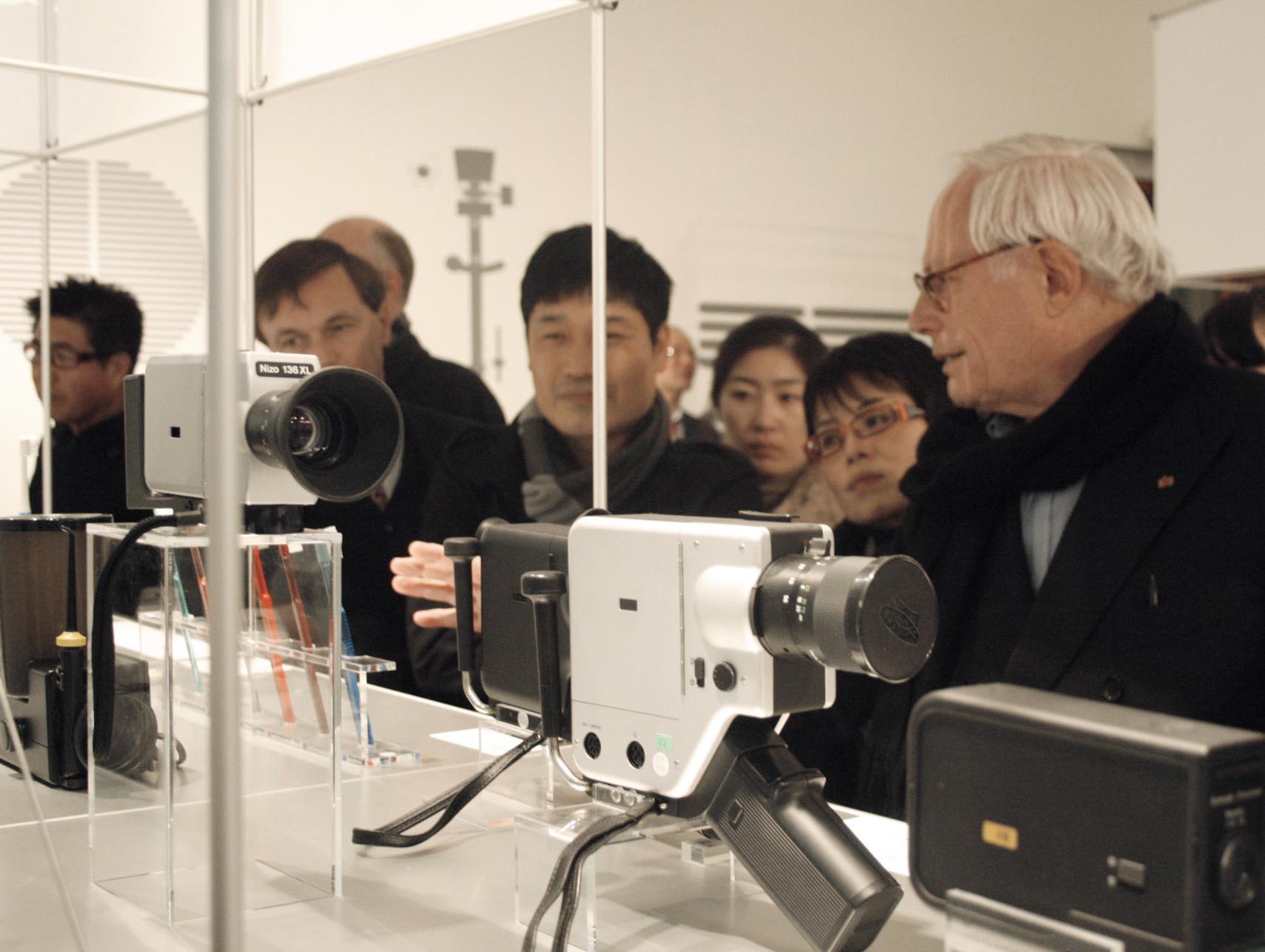
When considering Braun’s relationship with Asia, it immediately becomes clear that the German company has oriented itself internationally from the very outset. This is true both in terms of its products and sales markets. The Volksempfänger radio, with its short range, was followed in 1933 by the Fernempfangs-Vorsatz for European reception. The T 1000 world receiver of 1963, with which all short-wave transmitters worldwide could be received, became legendary.
The founder, Max Braun, a successful technician at AEG in Berlin who moved to the Rhine-Main region for the sake of love, sets up his own business in Frankfurt a.M. in 1921 with just one product and a handful of employees. His new type of quick connector for broken transmission belts quickly became a bestseller and already in that same year at the Frankfurt Autumn Fair he found an English trading partner in Camp & Watson, who paid in British pounds and so rescued him from the German hyperinflation of 1923. Within just a few years, branches opened in the Netherlands, Switzerland, Spain, Tunisia and Morocco. A factory of his own was built in England with the first phonographs, while France became the most important export country for Max Braun’s record player arms.
In 1937, Braun formed part of the German contribution to the world’s fair in Paris. The company presented its own stand at the International Exhibition in Thessaloniki two years before and is promptly awarded a Grand Prix for the battery powered Koffersuper BSK 36.
Erwin and Artur Braun, the company’s next generation, continued to take an international approach after the Second World War. The USA became the most attractive market. In 1954, the company successfully signed a licensing agreement for razors with the US manufacturer Ronson for a phenomenal sum of 10 million dollars. This was the largest German foreign business agreement of the post-war period. Erwin Braun later described it as his greatest youthful sin, since Braun was not allowed to sell under its own brand name on the American market until 1975. They could also not really do much business there with household appliances and hi-fi systems. The competition was fierce, technically at least equal, and usually cheaper. Exports are primarily to Northern, Western and Southern Europe, but also to Poland and Yugoslavia. In the 1967/68 business year, foreign sales accounted for fifty-five percent of the total sales.
Japan
In 1959, Braun was represented for the first time at a German travelling exhibition at the Japanese Council of Industrial Design in Japan and again there in 1965 with the entire programme. In 1973, Braun was invited to present itself extensively at the ICSID Congress in Kyoto. Fritz Eichler, Dieter Rams and Wolfgang Schmittel attended.
Since the sixtant, shavers have been the financial backbone of the company and Japan quickly becomes the largest overseas market. From as early as the 1964/65 business year, Braun has had a market share of twenty percent there. At times it even is the market leader. With its first sixtant of 1962, as well as its successor models, Braun has produced appliances that are as elegant as they are reduced in form and therefore perfectly compatible with traditional Japanese aesthetics. South Korea and China did not play a role at that time, but this was to change significantly in the 1990s. Since 2020, the new shaver known as pocket, designed in Kronberg, has been manufactured solely by Xiaomi Mijia in China and distributed there and from there.
In another area, however, Japan contributed to the elimination of the audio sector, which was so important for Braun’s identity. The Braun atelier hi-fi systems, despite being produced in Japan and Taiwan for financial reasons, were no longer able to compete with Sony, Panasonic, Sharp or Onkyo in terms of price and technology. In 1991, Braun’s American management took the decision to close down the loss-making product line. Today, only 30 years later, a new attempt is being made at an audio product line at Braun in the form of three smart loudspeakers.
Two Braun designers were, or are, particularly influenced by traditional Japanese aesthetics. In the first instance, there was Gerd A. Müller, who had already familiarised himself with the country through books, as an enthusiastic cook through Japanese cuisine and then also by way of trips to Japan. And then came Dieter Rams. At the ICSID Congress in Kyoto in 1973, he had the opportunity of providing an extensive presentation of Braun design together with Wolfgang Schmittel and Fritz Eichler. The itinerary for this event gave him with an invaluable insight into traditional Japanese architecture and aesthetics. Like many other German representatives of modernist design, such as Hermann Muthesius, Bruno Taut or Walter Gropius, he regarded it and European modernism as kindred spirits. This enthusiasm can still be seen today in the garden of the Rams’ home in Kronberg, which was created in 1970.
Three decades later, in 2005, Dieter Rams exhibited his work in the Kennin Temple in Kyoto, which was organised by Miki Shimokawa. For Rams it remains his most memorable exhibition in Asia on account of the historic architecture.
© Jörg Hempel
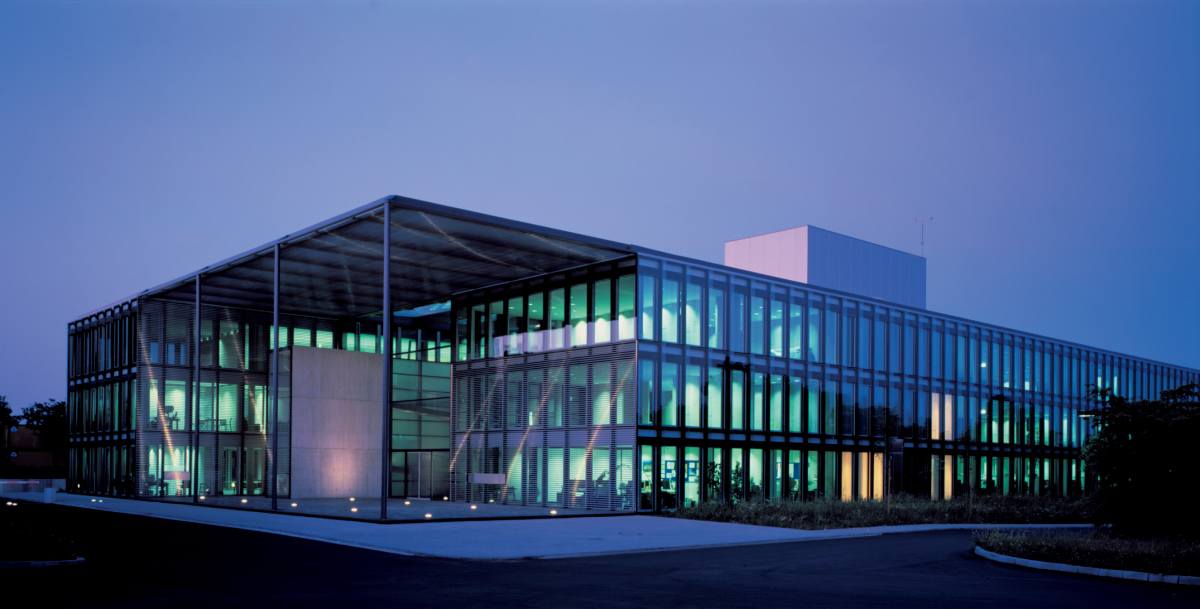
GT: Paul Watzlawick famously said: ‘You cannot not communicate.’ In this case, that could mean that even quiet, understated architecture is bound to carry a message. Before the actual design process, do you make a kind of list of keywords or characteristics that a building should exude?
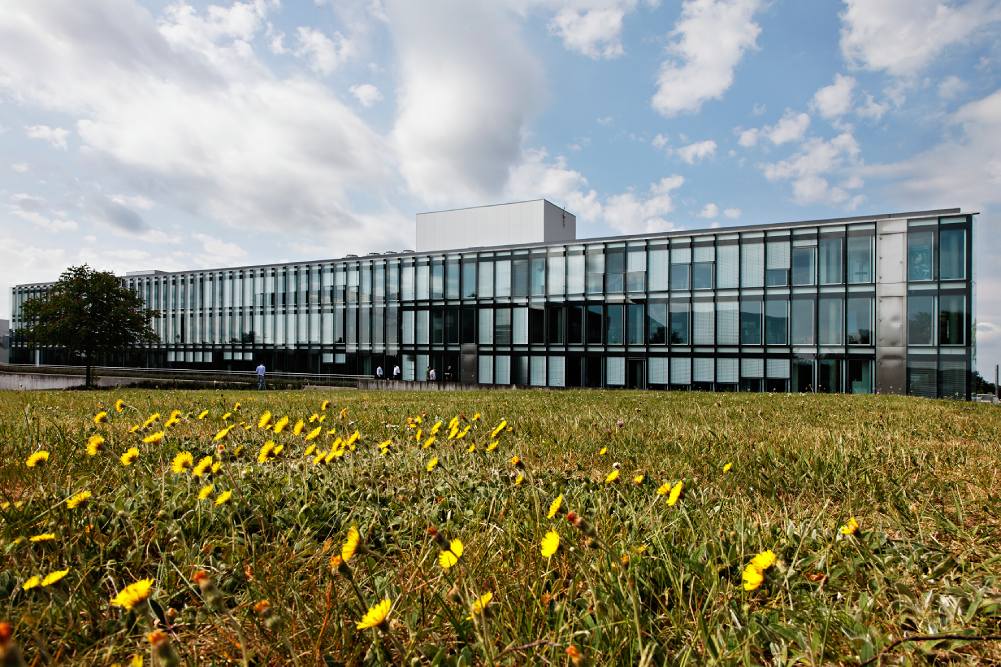
TS: That was indeed the case with that building. Some of the ideas were already formulated in the briefing, others came from Braun’s design approach. For example, the idea of a self-explanatory design really impressed us. It also had an impact on the building’s layout, in relation to the entrance being easy to find and ensuring that no questions arise. When you enter this hall, some elements help to guide you to find your way through. This quickly gives you an overview, in terms of how big it is or how many floors it has, so that you can orient yourself quickly and easily. We also made sure that we reduced everything to what is really needed. Glass elements in the façade can be opened up like the outstretched wings of a bird in order to allow air to circulate. In addition, there are two layers in the façade, so the blinds can be adjusted as desired on the frame, individually and without remote control, in the same way that the outer façade panel opens automatically when the ventilation flap is opened. Originally, the building location was planned differently, namely where the car park is today. Our argument in favour of placing it along the road was that it was an opportunity to create something new. This was ultimately accepted.
© Kirsten Bucher
GT: Did you have any kind of relationship with Braun or Dieter Rams before the Kronberg building project?
TS: I was familiar with Braun, naturally. I was aware of the alarm clocks. My first shaver was a Sixtant 8008, which I used for many years. I still have it today, though it unfortunately no longer works. I haven’t thrown it away because I just like it as an object. I liked holding it in my hand. Back then, I couldn’t afford a Braun stereo system. I did, however, have a Braun coffee machine, hand mixer, and an electric toothbrush.
GT: And Rams?
TS: We became aware of Rams when we participated in the competition involving Braun’s headquarters. He was there when we won first prize, though we didn’t have that much contact at first. I think he looked on it favourably. A real relationship began to develop when we acquired his Vitsœ shelving system for our office. It was almost like a typical little showroom. We met Rams more often over the years, also through Klaus Klemp, who established the contact. It was always a pleasure for us to see each other. The fact that Dieter Rams was, or still is, an architect himself means that he has this affinity with architecture and architectural issues.

© Vitsœ
GT: He also designed the Schwarzer Stern (“Black Star”) administration building on the Braun company premises in Kronberg and he contributed to the design of the Roter Hang (“Red Slope”) housing estate, giving it impetus.
TS: His house, which is actually a semi-detached house, is a dream. Its spaciousness and clarity, in terms of how you find your way around, also represents a closeness to people and the way in which one relates to the property on the estate.
GT: In the film about Rams by Gary Hustwit, an aerial view shows the basic structure of the estate. It’s quite densely built with a highly efficient utilisation of space, yet it also has its own rhythm and provides enough space for the residents. You go there several times a year because you are also active on the board of trustees of the rams foundation. Is there something that you have learnt from Dieter Rams, or that particularly interests you about his design approach?
TS: I think a few things have already been mentioned, such as how to create a certain density and clarity through the concentration and reduction of a design. His credo ‘Less, but better’ certainly holds true for some of our projects. In this context, Egon Eiermann also had a wise saying: ‘Make it as simple as possible—whatever the cost.’ This sentence illustrates that it is not easy to create something simple. On the contrary. It often takes a lot of effort. After all, simplicity is also about precision and care.
GT: To achieve this goal, architects must choose suitable clients. One should pull together. There was a mindset at Braun from the mid-1950s onwards, an attitude in the company, that wanted to bring about exactly the kind of clarity and simplicity that was in line with Rams. It’s 2025 now and you are also realising projects in China. When I see some Chinese skylines, I’m reminded of amusement parks where every building wants to be more exaggerated than the next. How do you deal with such an environment?
TS: This type of thing is known as ‘look at me architecture’, when against all odds, no matter where a building is located, no matter what purpose it is intended to serve—a form of expressiveness is sought. This begs the question: what’s the point? What solutions does it offer? Does this building provide insights into urban space? Does it benefit users or investors? What is it actually there for? Most likely to benefit the investors. We tend to work in a more silent way, formally speaking . And if things go well, we build up a relationship with the clients. No matter whether they are private clients, where it’s easier, or institutional clients. In the public sector, contracts are usually awarded through competitions. If you win over a jury, you also have a stronger backing for your proposal. Over the course of our more than thirty-five-year history, there have been perhaps two or three occasions when our clients and ourselves didn’t see eye to eye—when we decided that it didn’t make sense to carry on with the working relationship. And we parted ways entirely by mutual agreement. That’s why we always start with a low-threshold project, make a proposal and, if we like it, we’re keen to continue. If we don’t get on with the response, or if we realise that our views on things are too different, then it’s pointless to continue working together.
© Kirsten Bucher
GT: In contrast to design, large firms in architecture were often founded by a duo, such as Herzog & de Meuron, Bethem Crouwel, SANAA, Lacaton & Vassal … Why is that?
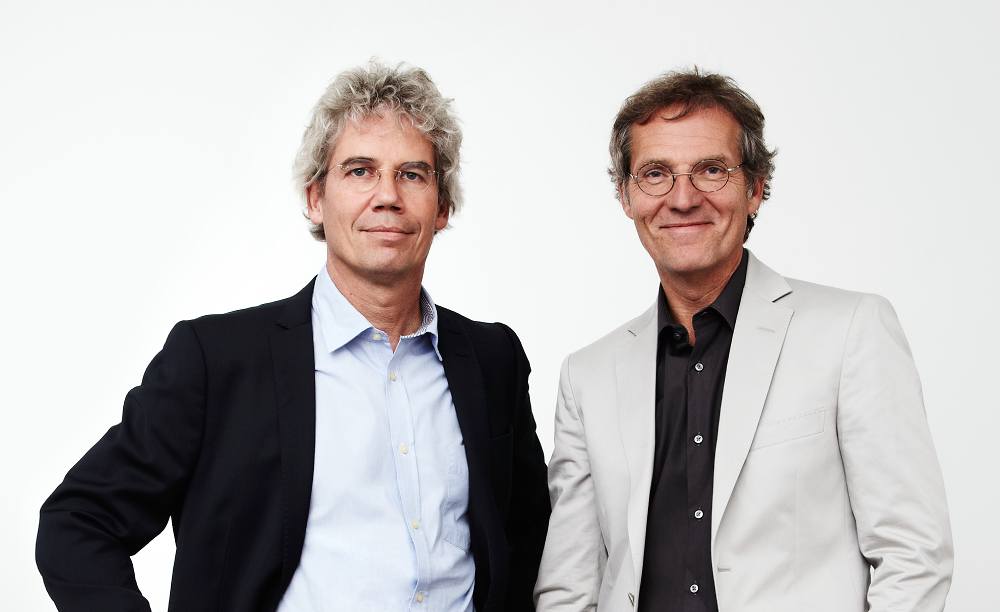
TS: Architecture is a complex field. Due to the multitude of issues that influence architecture today, for example building law, the issue of sustainability and its associated preconditions … with so many aspects it’s good to have a partner on an equal footing with whom you can exchange ideas and get along.
GT: How exactly is your partnership with Michael Schumacher structured? Is there a fixed separation of responsibilities?
TS: Let me put it this way: we are relatively similar in our perspectives. Michael is the more extroverted of the two of us. His professorship also lends him a different external presence. When it comes to a design, we always decide which of us will do it. It’s better if one of us is responsible for the design. If that person feels like it, then he gets the other one on board by saying: ‘Here, I need to show you something’. But neither of us necessarily has to follow what the other suggests or remarks on. Each can say: ‘Okay, I’ve heard that now, I’ve understood—you would do it differently. I’ll still do it this way though.’